 info@theclinivex.com
  +1 (877)-861-1996



Dissecting Equipment 101: Tools, Techniques, and Applications
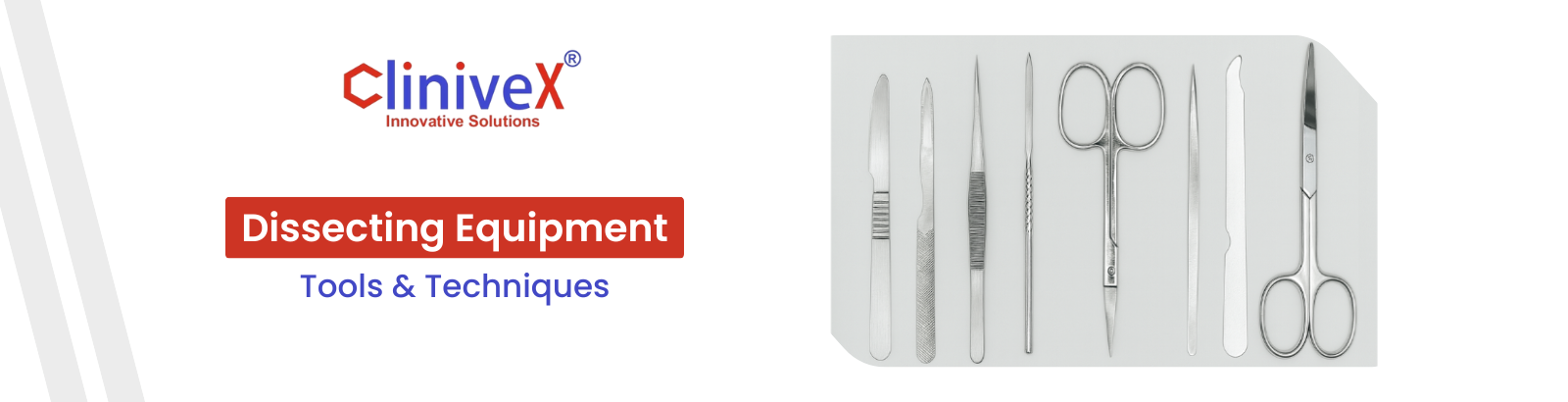
Dissection equipment! I am sure you might have seen them or heard them before! From the classroom to the research lab, dissection equipment serves as a foundation for any scientific endeavour. With these instruments, students can not only visualize biological structures but also investigate sophisticated tissues at an anatomical scale. Quality laboratory equipment supplier partners are critical to providing reliable instruments that facilitate safe and accurate scientific inquiry.
Dissection equipment is a primer that introduces you to the fundamentals of dissection, what dissection instruments are, how they are to be used, and what they can do for you.
Whether you are a novice who is just dipping their toes into the world of the life sciences or a seasoned researcher hoping to hone their technique, this guide will take you through the instruments and methodologies, and in some cases, real applications that will demonstrate the importance of dissection in serving the scientific process.
Dissection Equipment: Types of Tools and Their Applications
- Scalpels
- Scissors
- Forceps
- Dissecting Pins
- Dissecting Trays
- Dissecting Microscope
- Probe
- Razor Blade
- Magnifying Glass
- Dissecting Needles
- Scalpels Blades
- Dissecting Scissors
These are small, sharp knives that are used to make incisions in tissues.
These are used to cut through tissues and structures and also to remove organs or tissues from the specimen.
Forceps are used to grasp and manipulate tissues or organs, as well as to hold sutures in place.
These are used to hold tissues in place during dissection.
As the name implies, these trays are used to hold the specimen and the dissecting equipment.
These are specialized microscopes used to view the specimen during dissection at high magnification.
This is a tool used to explore tissues or organs or to separate tissue layers.
This is used to make fine cuts and sections.
This is used to magnify and examine small structures or details.
These are used for dissecting small structures or teasing apart tissue layers.
These replaceable scalpel blades come in various shapes and sizes to suit different cutting needs.
The scissors have blunt or rounded tips, allowing the user to cut delicate tissue while protecting surrounding structures from damage.
Conclusion
Dissecting equipment from lab equipment suppliers is indispensable for accurate and confident scientific exploration. Each piece of equipment, from the scalpel to the microscope, assists with safe and precise dissection and enhances understanding of biological structures. Working with a reputable laboratory equipment distributor can help students and researchers succeed in learning and develop valuable discoveries in education or research.