 info@theclinivex.com
  +1 (877)-861-1996



How a Vortex Mixer Makes Mixing Easier
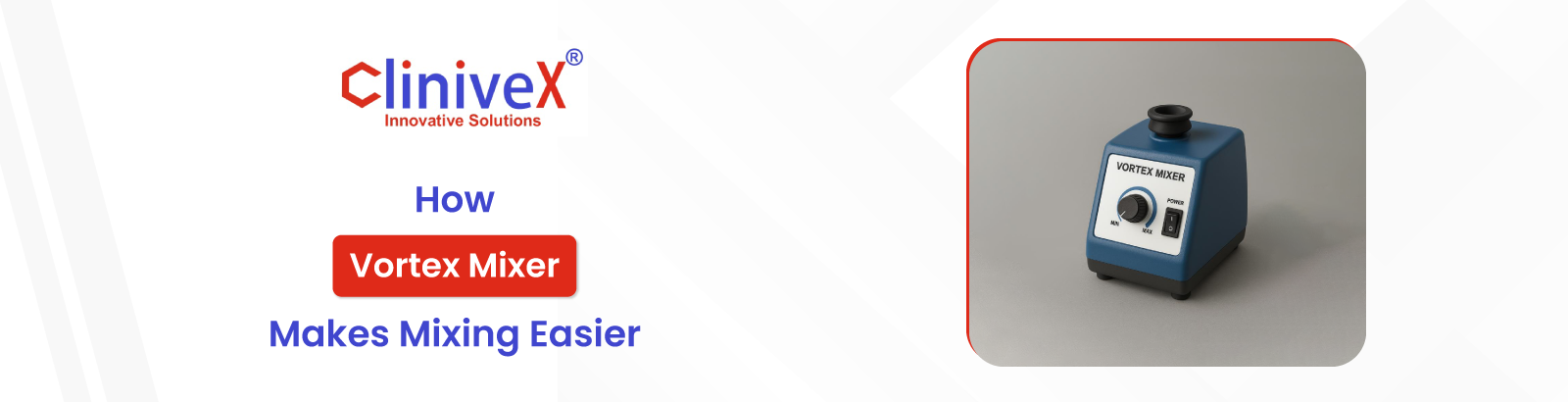
How a Vortex Mixer Makes Mixing Easier
Vortex mixers are one of the most essential equipment in clinical and research laboratories. They offer a rapid and efficient solution for mixing fluids and suspensions. Vortex mixers simplify lab operations across various industries.
In this blog, we are going to explore the benefits of vortex mixers and how to use them properly. First, let us understand in detail what vortex mixers are.
What Are Vortex Mixers
Vortex mixers are laboratory equipment used to efficiently mix, blend, or agitate fluid samples in test tubes, well plates, or flasks. It was developed by brothers Jack A. Kraft and Harold D. Kraft while working at Kraft Apparatus, Inc. in New York.
Components of a Vortex Mixer
- Main Switch
- Motor
- Speed Controller Knob
- Operation Controller Button
- Time Display
- Speed Display
How Do Vortex Mixers Work
Vortex mixers have motorized drive shafts that oscillate under the sample platform to transmit swirling motion to sample containers placed inside the mixer. The drive shaft is placed vertically, and a cupped rubber piece is positioned a bit off-center. The rubber piece will quickly oscillate in a circular motion when the motor is turned on. This results in a "vortex" motion that is comparable to stirring but does not involve any stirring component.
There are also controls present on the vortex mixer that can be used to adjust the speed and operation mode.
How to Use a Vortex Mixer Properly
Step 1
First, place the vortex mixer on a firm and level surface. Also, make sure no debris or residue can interfere with the mixing.
Step 2
Before you start mixing your sample, make sure that it is adequately prepared and includes all the materials required for the experiment. Close the sample container tightly to prevent spills.
Step 3
Make sure that the sample container is correctly positioned on the vortex mixer to avoid any unwanted movement or tipping during the mixing process.
Step 4
Now comes the mixing part. Start the vortex mixer at a low speed. Then, gradually increase the speed needed to obtain the desired amount of mixing or agitation. Keep checking the vortex formation to ensure it does not weaken or break apart.
Step 5
Once you are done mixing, clean the attachment or platform to make sure it is clear of any residual material. Use proper cleaning products and methods as advised by the manufacturer.
Conclusion
The versatility of vortex mixers makes them invaluable across a wide range of industries, such as biotechnology, pharmaceuticals, food, and environmental science.